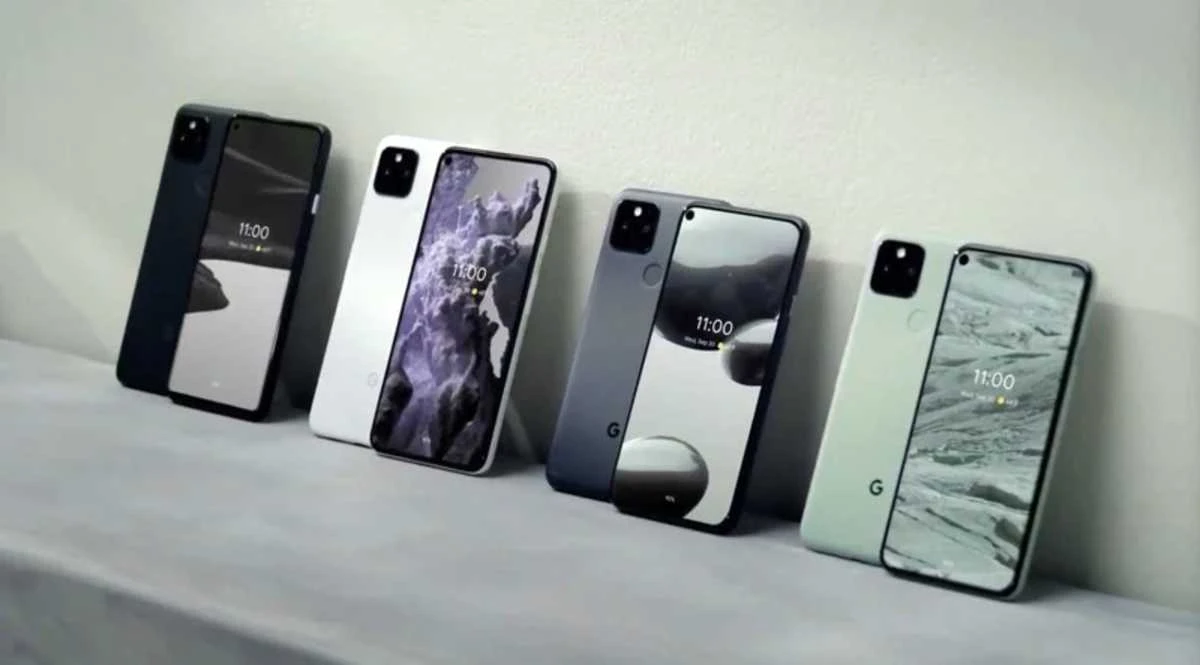

Google has unveiled its latest Pixel phones for 2020, the Pixel 5 5G, a 5G model of the Pixel 4a, and the Pixel 5. Too many, it’s a confusing bunch. Let’s take a further look and compare the spec and features of the Google Pixel 4, 4a, 4a 5G and Pixel 5.
The Pixel 4 and 4XL are 2019’s flagships, while the Pixel 4a is an entry-level device that strips out some features in favour of a more attractive price. The Pixel 4a 5G is a 5G version of the 4a, although hardware-wise it’s not too far behind this year’s flagship, the Pixel 5.
Size
When it comes to size, the Pixel 5 and 4a are very close to the same size, as the smallest devices on offer here. The Pixel 4 is a little taller but slightly narrower, then the 4a 5G is bigger in all three dimensions. And finally, the Pixel 4 XL remains the biggest of the bunch.
Weight
Weight-wise, these phones follow the same order as above, although there’s a much wider gap between the featherweight Pixel 4a and the 5. Between the whole group, the difference is 50 grams.
Build
The two 4a models have polycarbonate bodies, with glass fronts. The Pixel 4, 4 XL and 5 are made with aluminum and glass for a more premium look and feel.
Display
Coming to screen size, the base model Pixel 4 sports the smallest display of the bunch, at a diminutive 5.7 in, followed closely by the 4a on 5.8 in. The Pixel 5 is next in line at 6 in, then the 4a 5G at a respectable 6.2.
When it comes to display resolution, it’s a three-way tie between the Pixel 4a, 4a 5G and 5, on 2340 x 1080. These three models have different densities though, due to the fact that they’re fitting the same amount of pixels into different-sized screens. And the Pixel 4 brings up the rear.
All of these phones are made with organic light-emitting diode (OLED) displays, which is the direction the industry has been moving for a while.
Processor
All of these phones are running Qualcomm Snapdragon processors. The Pixel 4 is built on 2019’s flagship processor, the Snapdragon 855, but this year Google has gone for slightly lower-end options. Powering the Pixel 4a 5G and Pixel 5 is the Snapdragon 765G.
The entry-level Pixel 4a, meanwhile, is running on a Snapdragon 730. This mid-tier processor is no match for the flagships, but allows Google to lower the cost.
Storage
The Pixel 4 series devices are all running on 6 GB of RAM, while the Pixel 5 ups things to 8 GB.
The Pixel 4 comes with the options for either 64 or 128 GB of storage space built-in. The 4a, 4a 5G and 5 don’t bother with the lower tier.
None of these phones offers the option to expand that with MicroSD cards.
Camera
All of these phones have the same selfie cam, sporting eight megapixels (MP) and an aperture of f/2.0.
The difference is that the Pixel 4 also has infrared sensors that can measure depth and motion, which powers the facial recognition unlock system and the tech that recognizes gestures made in front of the device. These features seem to have been stripped out of the newer models for whatever reason.
The main camera setup is very similar across the board, with all four having a 12.2 MP camera with an aperture of f/1.7. On the Pixel 4a that camera is flying solo, but the other four models pair it with a 16 MP camera as well.
On the Pixel 4a 5G and the Pixel 5, that 16 MP camera has been given an ultra-wide lens, letting users squeeze more into frame.
The cameras on all four Pixels have more or less the same capabilities. They can all snap photos with high dynamic range (HDR), with the help of dual exposure controls. They can take it all in with panoramic shots, or zoom right in digitally with a feature called Super Res Zoom. Google’s Night Sight lets in more light for brighter and clearer photos in the dark. Portrait Mode can make photos look a bit more artful by blurring the background to different degrees – an effect called bokeh.
Top Shot mode helps users capture the best image of a subject in motion by recording a “motion photo” and pulling the best still frames out of it. Augmented reality (AR) can project virtual characters and objects over the real world as viewed through the camera.
Video
Again, the video modes on all five phones are similar, with both Optical and Electronic Image Stabilization (OIS/EIS) built in to help smooth out shots.
They can all shoot in 4K resolution at 30 frames per second (fps), while the Pixel 4a 5G and 5 can boost that to 60 fps. In Full HD, all five can shoot at 30 or 60 fps.
The four Pixels can also shoot in slow motion at two speeds – 120 fps with Full HD (1080p) resolution, or at 240 fps with a HD (720p) resolution.
The Pixel 4 and 4 XL has infrared sensors that allow the phones to be unlocked with a quick scan of a user’s face. For the 4a, 4a 5G and 5, Google has gone back to the old fingerprint unlock system, with the sensor located on the back.
Battery
The Pixel 4 has the smallest-capacity battery, on just 2,800 mAh, while the 4a fares slightly better on 3,140 mAh. Next in line is the 4a 5G at 3,885 mAh and finally the Pixel 5 on a hefty 4,080 mAh.
All five Pixels can be fast charged out of the box. The Pixel 4 and 5 support wireless charging as well. The Pixel 5 also has Reverse Charging, which lets you wirelessly charge other devices like phones and smartwatches by placing them on top of the Pixel.
Water Resistance
The Pixel 4 and 5 all have a water resistance rating of IP68, which means they can shake off splashes of water and survive being submerged in up to 1.5 m (4.9 ft) of water for up to 30 minutes.
The Pixel 4a and 4a 5G, however, have not been rated at all
5G
The Pixel 4a 5G and the Pixel 5 can both tap into 5G cellular networks, which are much faster than the widespread 4G.
Ports
All four Pixels charge via USB-C. The 4a and 4a 5G also see the return of the once-common 3.5 mm audio jack, in case you haven’t yet made the switch to Bluetooth headphones.
OS
The Pixel 4 and 4a all come with Android 10 pre-installed, but can now be upgraded to 11 anytime. The Pixel 4a 5G and 5 come with Android 11 pre-installed.
PIXEL 5 VS. PIXEL 4A 5G, 4A AND 4
| Google Pixel 5 | Google Pixel 4A 5G | Google Pixel 4A | Google Pixel 4 | |
|---|---|---|---|---|
| Display size, resolution | 6-inch FHD+ OLED 2,340 x 1,080 pixels | 6.2-inch FHD+ OLED 2,340 x 1,080 pixels | 5.81-inch OLED 2,340×1,080 pixels | 5.7-inch OLED 1,080×2,280 pixels |
| Pixel density | 432ppi | 413ppi | 443ppi | 444ppi |
| Dimensions (Inches) | 5.7 x 2.8 x 0.3 in | 6.1 x 2.9 x 0.3 in | 5.7 x 2.7 x 0.3 in | 2.7 x 5.7 x 0.3 in |
| Dimensions (Millimeters) | 144.7 x 70.4 x 8.0 mm | 153.9 x 74 x 8.2 mm (Sub-6 only) 153.9 x 74 x 8.5 mm (mmWave + Sub-6) | 144 x 69.4 x 8.2 mm | 68.8 x 147.1 x 8.2 mm |
| Weight (Ounces, Grams) | 5.33 oz; 151g | 5.93 oz; 168g (Sub-6 only) 6.03 oz; 171g (mmWave + Sub-6) | 5.04 oz; 143g | 5.7 oz; 162g |
| Mobile software | Android 11 | Android 11 | Android 10 | Android 10 |
| Camera | 12.2-megapixel (standard) 16-megapixel (ultra-wide) | 12.2-megapixel (standard) 16-megapixel (ultra-wide) | 12.2-megapixel | 12.2-megapixel (standard) 16-megapixel (telephoto) |
| Front-facing camera | 8-megapixel | 8-megapixel | 8-megapixel | 8-megapixel |
| Video capture | 4K | 4K | 4K | 4K |
| Processor | Qualcomm Snapdragon 765G | Qualcomm Snapdragon 765G | Qualcomm Snapdragon 730G | Qualcomm Snapdragon 855 |
| Storage | 128GB | 128GB | 128GB | 64GB, 128GB |
| RAM | 8GB | 6GB | 6GB | 6GB |
| Expandable storage | No | No | No | No |
| Battery | 4,000mAh | 3,800mAh | 3,140mAh | 2,800mAh |
| Fingerprint sensor | Rear | Rear | Rear | No |
| Connector | USB-C | USB-C | USB-C | USB-C |
| Headphone jack | No | Yes | Yes | No |
| Special features | 5G enabled water resistant (IP68) 90Hz refresh rate display dual-SIM capabilities (nano-SIM and e-SIM) reverse wireless charging fast charging | 5G enabled dual-SIM capabilities (nano-SIM and e-SIM) fast charging | Dual-SIM capabilities (nano-SIM and e-SIM) fast charging | Soli motion sensing and touchless gestures 90Hz display water resistant (IP68) dual-SIM capabilities (nano-SIM and e-SIM) wireless charging |
| Price (GBP) | £599 | £499 | £349 | £669 (64GB), £769 (128GB) |